You're not sure if you're making enough on parts, or if your markup is costing you customers. Here's how Nolavi works through it, the same way a good mechanic works on a car: find the concern, the cause, the correction, then verify the fix.
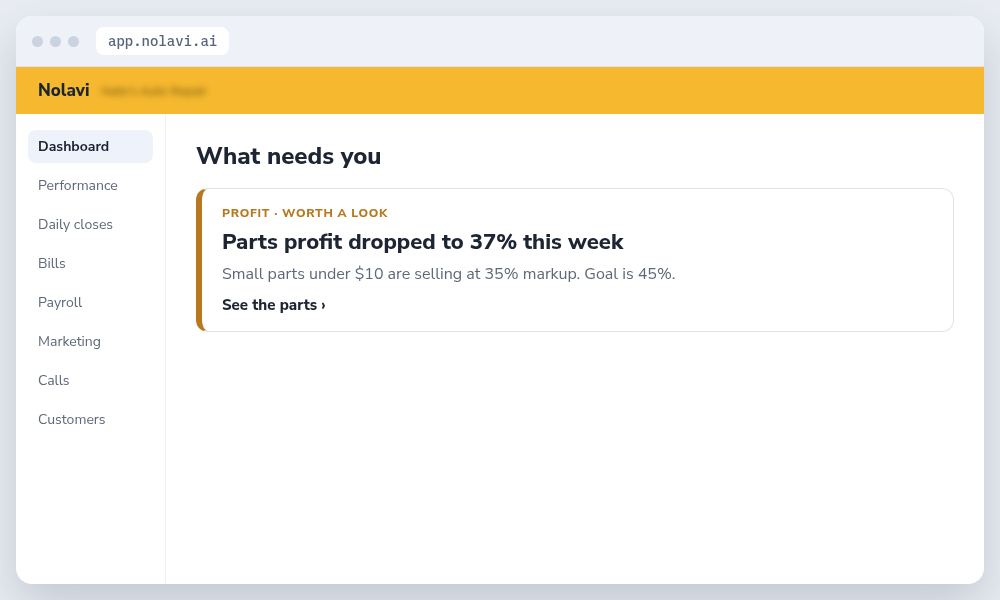
Nate had one markup rate: 40% on everything. His parts profit was 38% when it should have been closer to 45%, and he couldn't tell why.
Set once. Nolavi tracks whether it holds.
2
The cause
A flat markup loses money on cheap parts and undercharges on expensive ones. Nolavi matched every part sold to what was paid for it and found that small parts under $20 were being sold at almost no profit, and high cost parts over $200 were being sold below the market rate for installed parts.
Flagged before it becomes a month of lost margin.
3
The correction
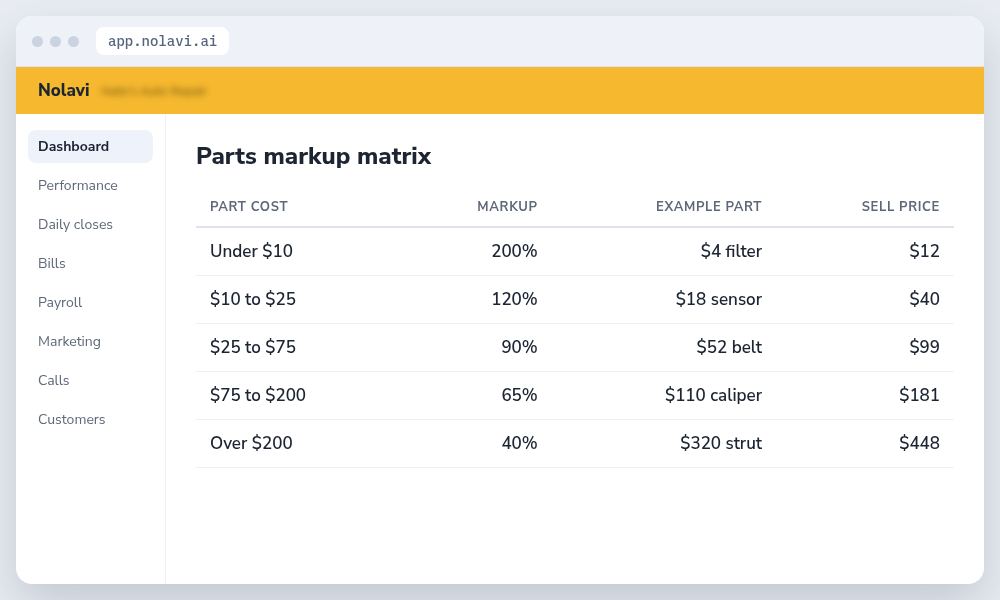
Nolavi uses a markup matrix: higher percentages on low cost parts, scaled down as cost rises, with a floor that keeps parts profit healthy at every tier. The matrix is set once. Nolavi tracks actual parts profit each week and flags any week it drops below goal.
4
The verification
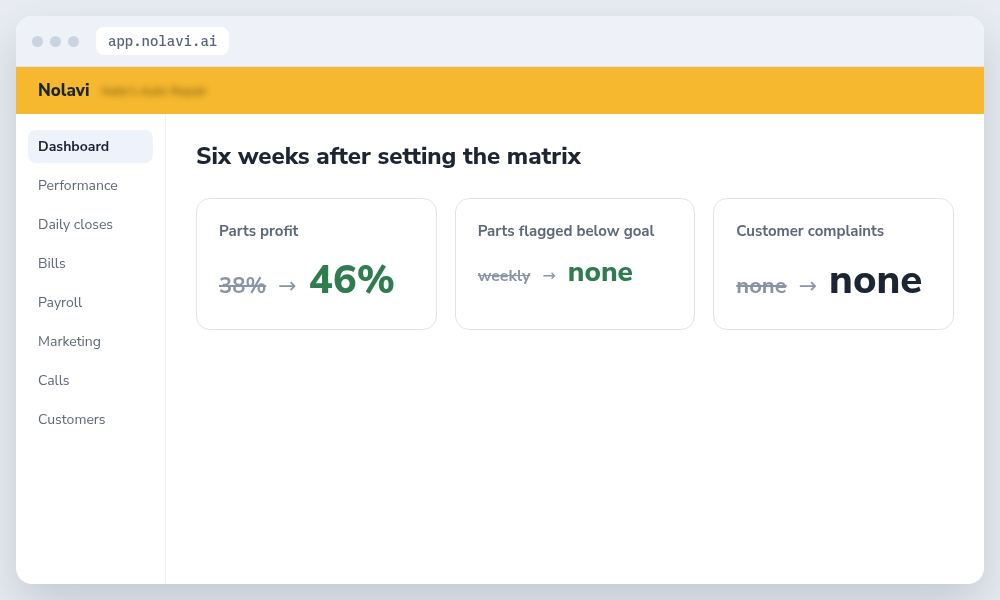
Parts profit went from 38% to 46% in six weeks without a single customer complaint. Nolavi now shows parts gross profit every Monday alongside labor and overall profit.
More parts profit, no pushback.
How we work. We make changes like this for shops all the time, using each shop's own data. The numbers shown are examples.
Auto repair shop coaching from your own numbers. Nolavi sends a plain report every Monday with the moves worth making next. See how it works
Questions
Quick answers.
What is a parts markup matrix?
A markup matrix sets a different markup percent for each cost range, usually higher for cheap parts and lower for expensive ones. It keeps parts profit steady without overcharging on big jobs.
What should parts profit be at a repair shop?
Most shops aim for 40% to 50% gross profit on parts. If yours is lower, check whether small parts are priced near cost and whether expensive parts have room to earn more.
Open the demo and find this kind of problem in a minute. Or book your 14 day free trial: it starts with a quick call, and we set it all up and fit it to your shop.
 Nolavi