Should I pay my auto repair technicians flat rate or hourly?
You want your techs to produce, but you don't want a shop full of people working against each other. Here's how Nolavi works through it, the same way a good mechanic works on a car: find the concern, the cause, the correction, then verify the fix.
Nate looked at flat rate because his billed hours were lower than he wanted. He talked to another owner who swore by it. But his two best techs said they'd leave if he switched, and he couldn't afford to lose them.
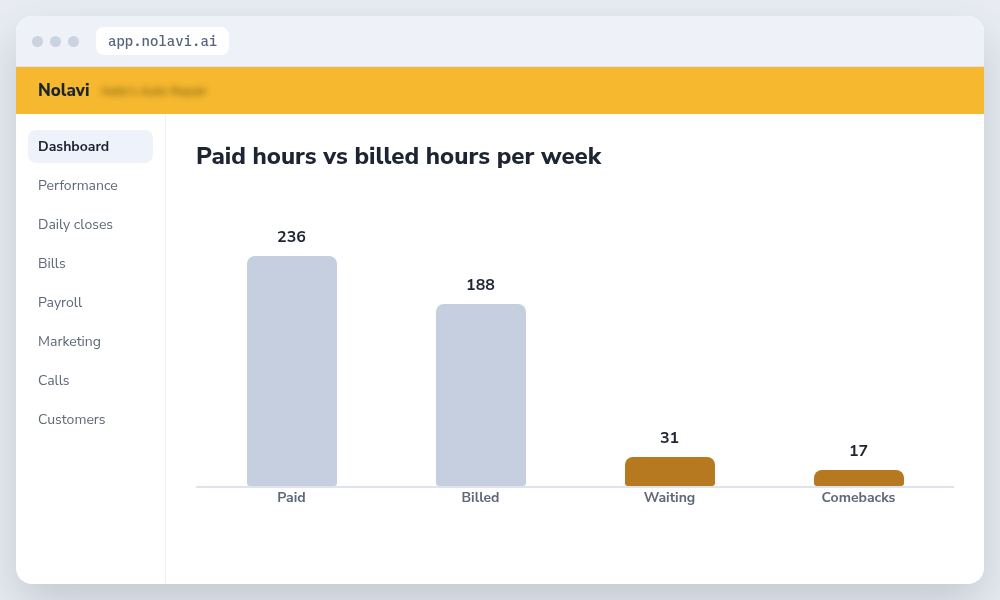
The gap shows exactly where the time went.
2
The cause
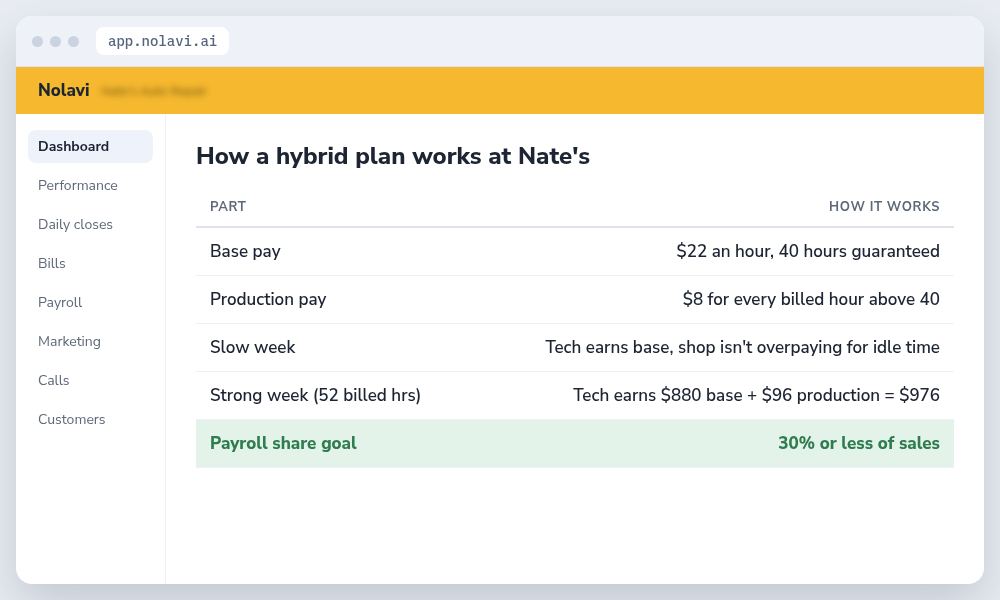
Flat rate rewards the fastest tech and punishes slow weeks, parts delays and comebacks. In a busy shop with steady work it can lift output. In a shop with slower stretches or a team feel, it often causes resentment, shortcuts and turnover. The problem isn't output: it's that output is the only thing being measured.
Steady income for the tech, output tracked for the shop.
3
The correction
Nolavi runs a hybrid pay plan: each tech earns a meaningful base that covers the slow weeks, plus production pay tied to billed hours. The base keeps good people when the week is slow. The production pay rewards the ones who turn work efficiently. Nolavi tracks every tech's billed hours, flags gaps between paid and billed time, and shows the owner where payroll sits as a share of sales each week. No spreadsheets.
4
The verification
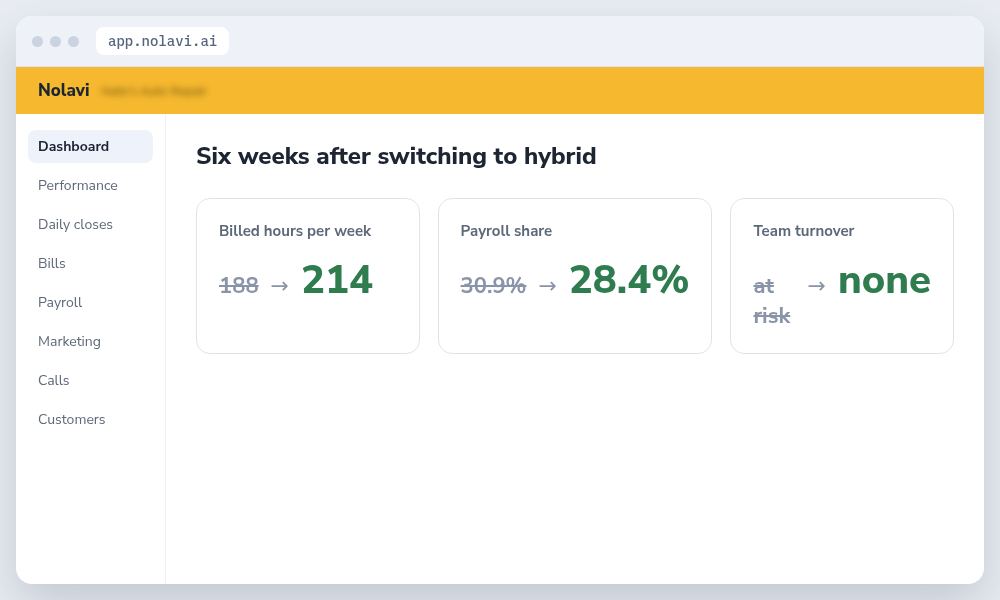
Nate's billed hours went from 188 to 214 a week over six weeks without changing the team. Payroll share dropped from 30.9% to 28.4%. Both techs who said they'd leave under flat rate are still there.
More output. No one left.
How we work. We make changes like this for shops all the time, using each shop's own data. The numbers shown are examples.
Questions
Quick answers.
What's the difference between flat rate and hourly pay for mechanics?
Flat rate pays by the job regardless of clock time; fast techs earn more, slow weeks mean thin checks. Hourly pays by hours clocked regardless of output. A hybrid plan gives a steady base plus production pay, so techs have income security and a reason to stay efficient.
How do I know which pay plan fits my shop?
Look at your billed hours versus paid hours each week. If the gap is big, production pay helps. If turnover is high or slow weeks are common, a base protects you. Nolavi shows both numbers every week so you can see what's happening before it becomes a problem.
Open the demo and find this kind of problem in a minute. Or book your 14 day free trial: it starts with a quick call, and we set it all up and fit it to your shop.
 Nolavi